UX Research
General Info
UX research focuses on understanding user behaviors, needs, and motivations through observation and feedback. Your product design should be built upon research and facts, not assumptions. UX research aligns what you, as the designer, think the user needs with what the user actually needs.
Foundational Research
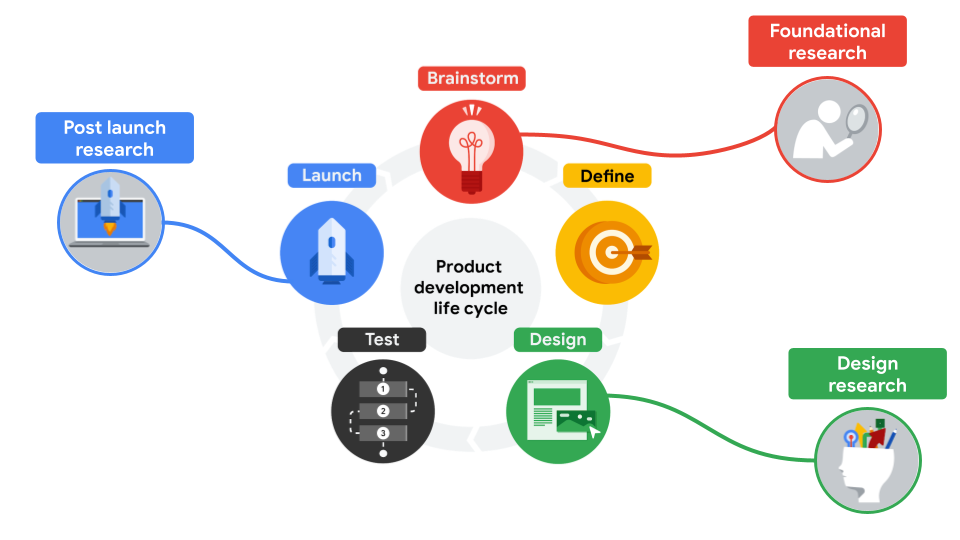
Foundational research is always done before you start designing. Within the product development life cycle, foundational research happens during the brainstorm stage (stage one) to help you empathize with users, understand their needs, and inspire new design directions. During this stage, you will also make personas and user stories, which you'll learn about soon.
Questions you might consider during foundational research include:
- What should we build?
- What are the user’s problems?
- How can we solve those problems?
- Am I aware of my own biases, and am I able to filter them as I do research?
There are lots of research methods for conducting foundational research, but many of them are based on observations. Common foundational research methods include:
-
Interviews: A research method used to collect in-depth information on people's opinions, thoughts, experiences, and feelings. You’ll often conduct interviews of your target users themselves.
-
Surveys: An activity where many people are asked the same questions in order to understand what most people think about a product.
-
Focus groups: A small group of people whose reactions are studied. For example, your focus group might bring together eight users to discuss their perspectives about new features in your design. A focus group is usually run by a moderator who guides the group on a certain topic of conversation.
-
Competitive audit: An overview of your competitors’ strengths and weaknesses. You'll conduct your own competitive audit later in the course, so you will understand this research method well!
-
Field studies: Research activities that take place in the user's context or personal environment, rather than in an office or lab.
-
Diary studies: A research method used to collect qualitative data about user behaviors, activities, and experiences over time. Often, a user will log, or diary, about their daily activities and provide information about their behaviors and needs, which can help inform your designs.
Design Research
Design research is done while you design. Within the product development lifecycle, design research happens during the design stage (stage three) to help inform your designs, to fit the needs of users, and to reduce risk. Each time you create a new version of your design, new research should be done to evaluate what works well and what needs to be changed.
In design research, your goal is to answer the question: How should we build it?
The amount of design research you conduct will vary depending on where you work and what you’re building. The most common method used to conduct design research is a usability study, which is a technique to evaluate a product by testing it on users. The goal of usability studies is to identify pain points that the user experiences with your prototypes, so the issues can be fixed before the product launches. You’ll conduct your own usability study in the next course of this certificate program.
-
A/B testing: A research method that evaluates and compares two different aspects of a product to discover which of them is most effective. For example, you might have users evaluate two layouts for the homepage of your app to find out which layout is more effective.
-
Cafe or guerrilla studies: A research method where user feedback is gathered by taking a design or prototype into the public domain and asking passersby for their thoughts. For example, you might sit in a local coffee shop and ask customers if they would be willing to test your app design for a couple of minutes and provide feedback.
-
Card sorting: A research method that instructs study participants to sort individual labels written on notecards into categories that make sense to them. This type of research is largely used to figure out the information architecture of your project, which we’ll discuss in the next course of the program — Course 3: Build Wireframes and Low-Fidelity Designs.
-
Intercepts: A research method that gathers on-site feedback from users as they engage in the activities being researched. Intercepts are often conducted in the field, so this type of research is often considered a subset of field research. An intercept study can provide quick, high-level feedback.
Post Launch Research
Post-launch research is done after the design is complete and your product has launched. Within the product development life cycle, post-launch research happens after the launch stage (stage five) to help validate that the product is meeting user needs through established metrics.
In post-launch research, your goal is to answer the question: Did we succeed? This research will tell you how your final product is performing based on established metrics, such as adoption, usage, user satisfaction, and more.
You should use research methods that give insight into what the user thinks of your product and if their experience using your product aligns with how you intended it to function. Research methods you might use to conduct post-launch research include:
-
A/B testing
-
Usability studies
-
Surveys
-
Logs analysis: A research method used to evaluate recordings of users while they interact with your design, tools, etc.
Types of Research
Primary Research
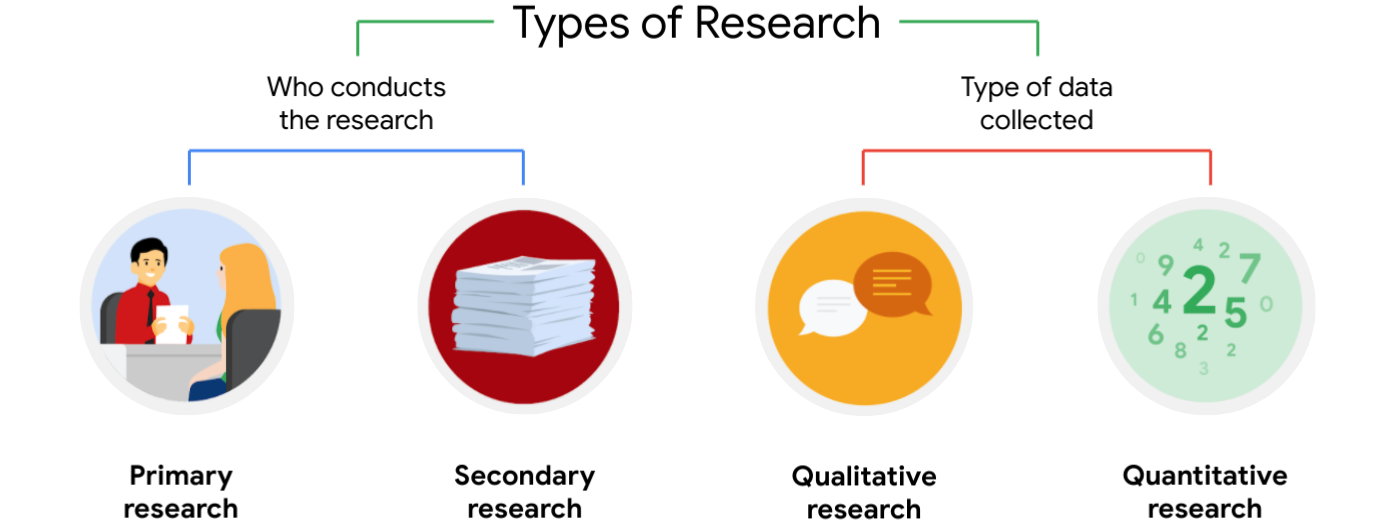
Primary research is research you conduct yourself. Information from direct interactions with users, like interviews, surveys, or usability studies, are considered primary research.
Methods:
- Interviews
- Surveys
- Usability Study
Secondary Research
Secondary research is research that uses information someone else has put together. Secondary research can be information from books, articles, or journals. You've probably done secondary research before and not even realized it.
Quantitative Research
Quantitative research focuses on data that can be gathered by counting or measuring. Quantitative research is often based on surveys of large groups of people using numerical answers. This type of research often answers questions like: How many? How much? If you want to know how the majority of users are experiencing a product, you should use quantitative research.
Qualitative Research
Qualitative research focuses on observations. Qualitative research is often based on interviews, where we focus on a smaller number of users and understand their needs in greater detail. This type of research answers questions like: Why? Or, how did this happen? If you want to know why users are having a bad experience with your product and how to improve it, you should use qualitative research.
Types of Bias in UX Research
- Confirmation Bias and ways to overcome:
- Ask open ended questions
- Active listening
- Include a large sample of users
- False Consensus Bias and ways to overcome
- Identify your assumption
- Survey large groups of people
- Recency Bias and ways to overcome
- Take detailed notes and recordings
- Interview participants consistently
- Primacy Bias...
- Take detailed notes and recordings
- Interview participants consistently
- Implicit Bias...
- Reflect on our behaviors ask others to point them out
- Sunk Cost Fallacy...
- Break down into smaller phases
- Outline points wether to continue or stop
Preventing Bias in Data Collection
- Choose your words carefully (avoid the framing effect)
- Foster independent thinking (avoid the bandwagon effect)
- Avoid Specific Language
- Limit the guidance you give users (avoid false consensus)
- Consider users tone and body language
- Be careful of your own body language and reactions (avoid social desireability bias)
- Plan your research effectively (Availability bias)
- Remain open minded (avoid primacy or recency bias)
Empathy in UX Design
How to empathize with users:
- Ask lots of questions
- Become more obervant
- Be an active listener
- Request input
- Have an open mind
- Keep current on UX Research
Empathy Map
An easily understood chart that explains everything designers have learned about a type of user.
Pain Points
- Financial Pain Points
- Product Pain Points
- Process Pain Points
- Support Pain Points
User Group
A user group is a set of people who have similar interests, goals, or concerns.
Personas
Personas are fictional users whose goals and characteristics represent the needs of a larger group of users. Each persona that you create will represent a group of users with similar characteristics that you’ve learned about through your research. Personas are key to the design process because they reflect the lifestyles of users and give your team an idea of how to meet users’ needs or challenges.
- Build Empathy
- Tell stories
- Stress Test Designs